Flicking through the newspaper I was intrigued by the images that I was presented with. At first glance the images looked like paintings but then when I began reading the article I realised that these images were not what I thought.
I was looking at real life rolling stones that could move hundreds of metres on their own!
In the intense 50º heat of the Californian Death Valley these rocks appear to wander around the desert in lines, leaving distinctive tracks in the sand.
With some of these rocks as heavy as 113kg it is hard to imagine these rocks moving without help, but it does happen! Scientists believe that a combination of elements push the rocks along the desert floor (90mph winds, ice formations at night and thin layers of wet clay on the surface of the desert).
These gliding rocks though might not be around for much longer as many believe that the rising temperatures could lead this phenomenon to disappear!
With thanks: Photo: http://www.indianpad.com/pics/86016/pic-the-mysterious-moving-rocks-of-californias-death-valley/
A lot of people refer to home as where their heart is, but where is home…? Is it where you live now, a place you grew up, where your parents stay now, where you wish you were…? Is it a building, a country, a town or simply a place where your familiar surroundings are?
A discussion I recently attended by Mhairi Bowe at the Sensations Science Centre in Dundee talked about psychology in the home. Predictable stereotypes of the word home like safe, familiarity and belonging were turned on their head within the first five minutes and we were asked to think about home in a new frame of mind. Talking about the past, present and future we were asked how this affected us.
Places have an emotional impact on us. By linking these emotions to the past, we can revisit these store houses (physically or mentally) and relive the memories we choose to. These strong emotional connections that we make may be meaningless to other people but to us they are personal.
By losing a place we are made to realise how much it meant to us. I am lucky in the sense that I have only ever lived in two houses my entire life. The first house I stayed is not far from where I stay now but because I moved to my present house when I was only one years old I can’t actually remember anything about the old house. Now I couldn't ever imagine moving away from my house, but why do we get so attached? So many things have happened in this house. Birthdays, Christmas’, special celebrations, etc.
Although we get attached to places, it is important sometimes to move on and find new comforts. Although moving out of home is a daunting prospect, it is also quite exciting wondering where I will end up.
Although my heart will always be in my childhood home, I hope that a new place someday could also share a piece too.
With thanks: Photo: http://oels.byu.edu/student/idioms/proverbs/home.html
Ever noticed that the essential things you need like bread and milk are always hidden at the back of the supermarket? This is no coincidence, supermarkets are purposely designed like this. How many times do you go into a shop with one or two things on your list and then how many times have you walked out with bags full of things you don't even need? (sometimes even forgetting the very thing you went in for!)
The book "Why we buy" by Paco Underhill, observes how we as humans respond to certain things. The results were very interesting, for example if you keep someone in a shop longer and if people shop with baskets they are more likely to spend more. Okay so you might be thinking yeah that's all pretty interesting but that's just common sense, well how about Primark. There are loads of folded displays where you have to look for your size, Underhill explains that we are more likely to buy something if we touch it. So by unfolding the clothes we are more likely to buy them out of guilt (consciously or subconsciously) than if they were hanging up. As much as I hate to say this I am guilty for this...Just after this lecture I went to Primark and bought some tops (after unfolding them). I knew fine well I was falling into the trap but I couldn't help myself.
We have all fallen victims to the advertising giants!
The Chelsea Flower Show is highly competitive and full of wonderful compositions of flowers…that was until James May turned up.Normally found behind a steering wheel on the television show Top Gear, James May has recently taken part in a small series of television programmes called Toy Stories. In this he brings back childhood pastimes to the present day and tries to encourage modern day children to become excited and take part in his experiments.In the second episode May tries to enter the Chelsea Flower Show with a garden made entirely of plasticine. He enlists the help of high school children, art students, ex-soldiers, etc to create a ‘masterpiece’. Nicknamed “Paradise in Plasticine”, the final result isn’t quite as bad as I thought it would be and May’s garden even went on to win the RHS ‘Peoples Choice’ award for the best small garden – not bad for a garden that was completely fake!
With thanks: Photo: http://golondon.about.com/od/rhschelseaflowershow/ig/Urban---Courtyard-Gardens-09/Paradise-in-Plasticine-1.htm Photo: http://www3.pictures.gi.zimbio.com/RHS+Chelsea+Flower+Show+Opens+Gates+Public+3t8YDmwDJ3Fl.jpg
Okay so I know the title has so much different ideas behind it and so many talking points but one thing I didn't realise it could relate to so much was food!
Early expectations of a talk I attended was that it would relate possibly to how we as designers could think harder and develop products that are friendlier to the environment...never assume!
Two hours was spent on educating us about our food waste and how that this was having devastating effects on our environment. Now, don't get me wrong this is all very interesting and as a designer everything is relevant to us but when you are not expecting this, you are caught a little off guard (and judging by the looks from my friends they were equally as surprised as me).
The underlying theme (and something that is very relevant to everybody) is that every action we take can have a knock on effect to the planet. Without sounding like an Eco-obsessed maniac, we as designers should be more conscious of our design decisions and also apparently we should celebrate ugly vegetables!
With thanks: Sustainability talk, Enterprise Gym, Dundee Photo: http://www.provokator.org/files/ugly_carrots.jpg
Recently I have gained a deeper understanding of just how much context effects design... Gaining information for my last task in the design studies assignments I began to truly understand how different environments provide different reactions to art and design. An example of this would be graffiti. Some people see this as a piece of art while others see it as vandalism, but why is this?
Context. Depending on many factors, e.g. where you were raised, what was happening in the environment around you, what you were interested in as a child, etc, these would all play part in how you respond to things. Personally for me I think graffiti is art, purely because it is not always just a spur of the moment thing. Some 'designers' think about where to place their graffiti for the best response and how to layer things so that some parts jump out and capture the viewer. Graffiti gets a better response in some areas than others so it is important for this to be taken into consideration. Graffiti is a platform for people to raise issues important to them so we as designers have to be careful about which we show case our design as some people may not respond how we want them to...
Birkbeck, C & LaFree, G 1993, ‘The situational analysis of crime and deviance’, Annual Reviews Inc., vol. 19, pp. 113-137.
Journal discusses the idea that crime and deviance are either situational or dispositional. This could relate to the context and upbringing of an individual and their susceptibility to crime.
Cassidy, T 2003, Environmental Psychology, Psychology Press, East Sussex
This Book provides an understanding how physical and social factors are linked to human behaviour and experience. Designers need to understand about an individuals response so as to create the best design. This book would be useful for a greater understanding on how people react differently to design.
Fowler, E.P. 1987, ‘Management and city design’, Social Forces, vol. 66, no. 2, pp. 365-389.
Explores the relationship between human behaviour and physical environment. Does this have any relation to how we as individuals respond to different things, e.g. design, graffiti.
Jarjoura, G. R., Tripplett, R.A. & Brinker, G.P. 2002, ‘Growing up poor: examining the link between persistent childhood poverty and delinquency’, Journal of Quantitative Criminology, vol. 18, no. 2, pp. 159-187.
Journal discusses the research that suggests poverty and delinquency are related. Upbringing of individual could be responsible for increasing chances of becoming involved in delinquency.
Krivo, L.J., & Peterson, R.D. 1996, ‘Disadvantaged neighbourhoods and urban crime’, Social Forces, vol. 75, no. 2, pp. 619-648.
Talks about areas of poor poverty and the high levels of crime – related? Useful for highlighting that some areas are worse hit than others for crime e.g. graffiti - possibly an explanation to this.
Leventhal, T & Brooks-Gunn, J 2003, ‘Children and youth neighbourhood context’, American Psychological Society, vol. 12, no. 1, pp. 27-31.
Discusses the neighbourhoods in which we are raised and their effects on personality. This in turn could affect how we respond to design so may be useful in understanding the influential things responsible.
Mackintosh, P.G. 2005, ‘The development of higher urban life’ and the geographic imagination: beauty, art, and moral environmentalism in Toronto 1900-1920’, Journal of Historical Geography, pp. 688-721.
This journal talks about how art can shape human behaviour. Relates to context and setting discussed in Brainstorm. Although this source was only published in 2005, the content is from 1900-1920 and may be slighted out of date for what I am to discuss.
Manco, T 2002, Stencil Graffiti, Thames & Hudson, London.
Discusses the history of graffiti and why ‘artists’ choose to participate in this illegal game. Might prove useful if talking about why people use graffiti as a means of communication. Also looks at specific areas where graffiti is e.g. London and Brooklyn.
Smith, S.J. 1984, ‘Crime and the structure of social relations’, Transactions of the institute of British Geographers, vol. 9, no. 4, pp.427-442.
Talks about how lifestyles and community patterns effect crime. Some areas are more susceptible to crime than others and this journal tries to help and explain this. Might be useful in trying to explain why people graffiti and commit crimes in certain areas more than others.
Stephen, S 2006, Designing safer places, Edinburgh, The Scottish Executive.
This report from the Scottish Executive talks about the different measures that are being taken when designing communities. Small changes in the way in which thing are built can have a lasting impression on our neighbourhoods. This would be useful in looking at specific examples of prevention of crime, etc.
Taylor, R.B. 1996, ‘Neighbourhood responses to disorder and local attachments: the systemic model of attachment, social disorganization, and neighbourhood use value’, Sociological Forum, vol. 11, no.1, pp. 41-74.
Discusses how neighbourhoods respond to disorder and the social involvement among them. Important areas may be researched into how communities respond to things. Different neighbourhoods have a different mix of people living in them and these are presented.
Part (b) Website sources (discipline related):
Dezeen Architecture and Design Magazine: http://www.dezeen.com/
Wired news: http://www.wired.com/
Royal Academy of Arts: http://www.royalacademy.org.uk/
RIBA: http://www.architecture.com/
Yatzer: http://yatzer.com/
Website sources (Non field related):
Science News from New Scientist: http://www.newscientist.com/
Red Jotter: http://redjotter.wordpress.com/
The Guardian: http://www.guardian.co.uk/
BBC News (includes Television and Radio): http://news.bbc.co.uk/
National Geographic: http://www.natgeochannel.co.uk/
'Back in the days' when my mum and dad were 'wee bairns' furniture was seen as something more of a practical form rather than a design statement. Weeks sometimes even months was spent saving for furniture and even then it wasn't always new. Now we can go into IKEA and come out with furniture that can fill almost an entire house. Ask anyone back in the 60s about flat pack and their response might be a load of wolves run over by a tank... Not what we would think of when asked what flat pack is today! Why is it now then that we are filling our homes with 'cheap' and wasteful furniture? Has furniture lost it's meaning?
We can spend pennies on furniture now but is it just as good as before? Well no, in my opinion, it's not. Planned obsolescence is an important factor for designers now who intend for the furniture to last only a few years rather than a lifetime. Old furniture grew up with the family and it was never replaced - it in turn was almost part of the family. We are now leading a very disposable life!It's all fine that we have taken a stance to cut our carbon footprint and recycle paper and cans but how can we really try and help when we still being wasteful with our furniture consumption? Furniture in my opinion no longer has meaning - it is just something that fades into the background and is there for the short term until a new trend comes around and we replace it again...a vicious circle?
With thanks: Photo: http://www.kitchenandtabletop.com/img/ikea_urban_chair.jpg
Seminar and Group Brainstorm This was a very enjoyable experience and brainstorming in two small sessions was very useful. To begin with there was a small, nervous silence but as soon as we got going, ideas were rolling off the tongue - sometimes too quickly to all be written down. We were all shouting out things and sometimes we found ourselves all laughing at the crazy ideas that we were coming up with. After our brainstorming session we went back as a group and reflected on what had been said before, generalising points.
Individual Brainstorm When looking into the points discussed in the previous brainstorms, I was able to expand on these and look at them in more detail. I could not believe how much design relied heavily on context. The smallest details like people's personalities and location could affect massively how they responded to design. Designers have to be switched on and sensitive to the people they are designing for.
An experiment in our Design Studies, pick a word for each category: person, emotion/action & possession.
Mother of three, running & television.
The most obvious could be the mother is chasing after her three children because they are all misbehaving so to get some time to herself she puts them in front of the television...too obvious?
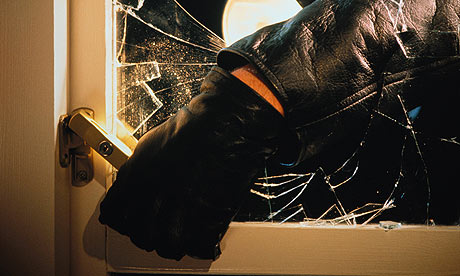
How about a single mother of three lives in a run down area and can't afford to feed her children. In an attempt to put food on the table she tries to steal a televisionin exchange for money but in the middle of the burglary she is disturbed and forced to start running away.
By changing the perspective a little we are made to see things in a new light. We as designers need to be able to look past the obvious and look at an object in a different way -sometimes ignoring past experiences.
With thanks: Photo: http://www.getrichslowly.org/images/burglary.gif
I feel I've been neglecting my wee blog for a while so I thought I'd upload some images of the work that I've been doing in class. Let me fill you in on my project... we have to design an exhibition based on the title Juteopolis. (Basically this was the nickname given to Dundee after the city was taken over by the Jute industry in the late 1800's and early 1900's.)In my group we decided to focus primarily on the connections within the community and decide to portray this through the human form all connecting...
We asked people to stand in specific positions so as to mimic jute weave patterns, street grids, etc but they were always connected in some way - the underlying theme...
In studio based time, we are currently undertaking a project called Juteopolis (based on the Jute trade in Dundee). Although we have our main project to concentrate on, we also have a mini project too from artist Louise Ritchie. At the 2009 Degree Show in Dundee she created an exhibition that was very unusual.
Most artists spend many painstaking days, months or even years on their work but Louise Ritchie took a different approach to creating her exhibition. She did something which I had never before been aware of...she asked other people to create the pieces for her show.
12cm³ blocks of wood were the 'canvas' that the work would be created on and participants were given a very open brief where they were able to paint, slice, burn, etc, their 3D sketchbook basing it all on the theme of Juteopolis.
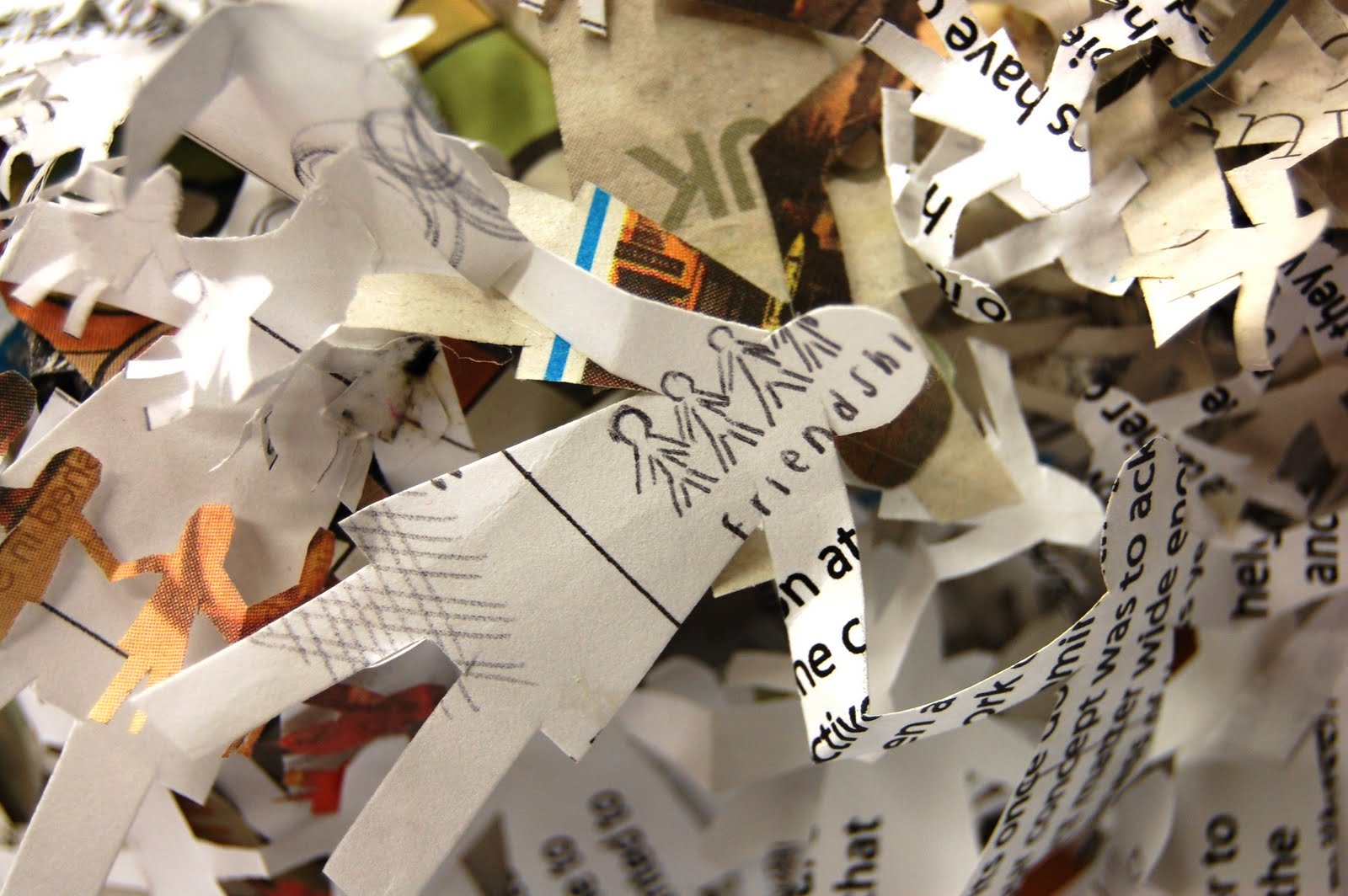
Bearing all this in mind I decided to focus on the connections of the Jute industry. In these times, people basically lived on top of each other in very poor living conditions - some small tenements were housing on average 8 people! Neighbours were almost like family and friendships were established within the Jute communities, all relating to the similar harshness.
The first thought that came into my head were paper chain people - all connected and all similar!
We as humans are very sensitive to the environment around us, whether we are conscious of this or not. In the chapter, The Power of Context (Part one), Gladwell presents Bernie Goetz to us. A seemingly 'normal' man, who was approached by four black youths and asked for $5 on a subway car. Goetz shoots at these youths and leaves one paralysed but is still hailed as a 'hero'. Crazy?
Three of these four youths were carrying screwdrivers (clearly looking for trouble) and they had all committed previous offences, so really Goetz was cleaning up the streets, wasn't he? I mean he was clearly a normal man who had had enough of the violent crimes occurring and decided to take a stand! Wrong! Gladwell and the reader delve into Goetz's past and learn about how he was merely an accident waiting to happen. He was a class example of an emotionally unstable person - bullied as a child, abused by his father, a social misfit... It was only a matter of time before the environment around him made him 'tip'.
Reading The Tipping Point was very interesting for me. Never before have I read a book that has made me think about things so much or agree with statements I had never questioned before. The book for me was very enjoyable but at times sometimes hard to read. Gladwell presents many ideas all at once, sometimes bringing points up which had be discussed previously and this sometimes confused me.
Creating the mind maps made me understand things more and reinforced ideas that initially I had found hard to understand. I choose the Power of Context chapter to look at in more detail because for me it was the most interesting chapter. I had never thought before that crimes could be committed because of the environment around us. Splitting the chapter into different parts allowed me to focus on key points, e.g. Crime, Goetz, etc, and mind map these into more detail.
The mind mapping allowed me to understand more of the book than would have been possible by writing screeds and screeds of linear notes. If I forgot anything while I was mind mapping the first time I could always go back and add more (even my own opinions).
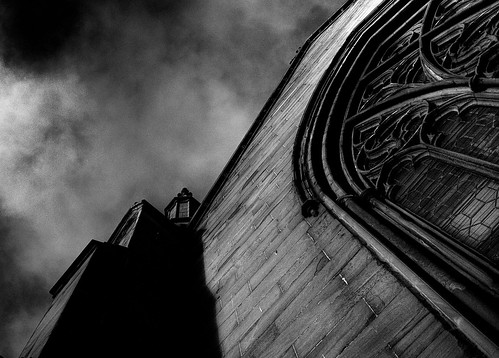
Walking through the town centre, I feel slightly intimidated by the amount of people passing by me that I know nothing about. Groups of people chattering excitedly, no doubt talking about what they did at the weekend and how drunk they got. Others merely stride past, submerged in their own thoughts while their ears are plugged from the outside world by their iPod. I am guilty of this also though. I speed through the city, iPod blaring cheesy pop music, subjecting myself to the typical city alienation.With the world passing me by, the only thing stopping me from my auto piloted progress is the disruption of people and the crossing of roads. This time though, instead of choosing to walk back to university with the blinkers on I decide to turn my iPod off and take a slower, more casual walk, allowing my feet to take me where they wander. It is only now I notice things that I've walked past countless times in hast and never payed much attention to. For over a year now I have walked the same way everyday and failed to notice things, one of these being St. Mary's Church. This church has one of the most beautiful exterior's I have seen in the whole city. The ornate windows and the detailing around the edge of the church is breathtaking. I don't understand how I have never noticed this before and how it has just blended back into the urban landscape. Now whenever I pass it, I cannot miss it!
This journey reminds me of book I came across a while back...Little People in the City. This is street based installation art at it's best! These little pieces of art are easily missed and only on careful observation can be seen - similar to my journey in the city. Check it out and let me know what you think... http://little-people.blogspot.com/
With thanks: Photo: http://inlinethumb44.webshots.com/41643/2172484200104237032S600x600Q85.jpg Photo: http://farm4.static.flickr.com/3087/2286418022_c68e68daaf.jpg
Everywhere we look there are symbols controlling how we respond to the environment around us. From warning signs to recycling signs, we are submitted to constant visual directions.
For instance, think of the colour red...what does it make you think of? Danger? Love? Attention? Passion? I'm sure at least one of these were in your head. So why is it that this is the case? After all the colour red is just that - a colour. It has no meaning, does it?
When you are walking past someone in the street wearing red, do you immediately feel frightened? Why not? I mean red means danger doesn't it? What about love? Do you suddenly feel drawn towards them? Well maybe but chances are it is not because of the colour of top they are wearing.
Are designers to blame for these associations? After all, warning signs, whether you are in Britain or China, are all red. Red catches your eye and because of this Scientists have recommended it be used for signs that are supposed to grab our attention - it was only a matter of time before advertisers jumped on this bandwagon to sell products! Take for example, Coca Cola. When I asked the question before what you think of when you think of red, did any of you think of Coca Cola? It's hard to forget about 'Coke' though seeing as it almost presents itself to us everyday, whether on the shelves in shops or in sport (e.g. Olympics, football sponsors) we are aware of it. Originally designed for medicinal reasons it was John Pemberton who first discovered this addictive concoction that was a supposed cure of headaches and morphine addiction . Is it not ironic that now many people cannot go a whole day without their 'coke fix'? I am all for the use of colour helping us in everyday life but I don't want it to affect the choices I make. Scientists are using it to help us but designers are using it to sell their products, is this right?
With thanks: Photo: http://www.yellericecream.com/Uploads/600px-Stop_sign_svg.png Photo: http://blog.mindblizzard.com/uploaded_images/Coca-Cola-723214.jpg