Showing posts with label People.. Show all posts

Friday, 5 March 2010

Tubing it in London City


On a recent trip to London, I experienced the Underground for the first time and for someone who comes from a small village in Fife, using the tube was a steep learning curve!


Observations made at the station


With an average of 3.4 million people using the tube daily, I have to admit I did feel like a minority. People were constantly rushing by me, banging and barging to get through and with so many rules to remember, I found myself feeling slightly nervous! Being constantly reminded to keep to the right and to walk fast to keep out of everybody's way, this was an experience that I was not going to forget in a hurry.


With this many people using the tube a day, safety is surely one of the most important aspects but with little Police presence I struggled to see how it was safe. The whole system lacked any human interaction to be honest...You walked into the station, bought your ticket at a machine, put your ticket through a barrier, went on a lift, checked when the next tube was available on computerised boards, got on the tube, hear instructions over the tannoy, get off train, travel up escalators, put your ticket through another barrier then leave the station. I would struggle to count on one hand the amount of workers on duty there yet no one seemed to be causing trouble. Everybody seemed to accept that the whole system was about getting people from a to b as efficiently as possible.

Travelling the tube at different times of the day allowed a different insight into how it operated. With a lot of people using the tube to get to and from work, morning and evening times seemed the busiest. Although I soon changed my mind... Attending two football matches (Brazil v Republic Ireland, Emirates Stadium, attendance - 40,082. England v Egypt, Wembley Stadium, attendance - 80,602) it really put into perspective just how heavily the network was relied on with the term "Sardines in a can" being the most suitable phrase here. I was up close and personal with complete strangers and I'm just thankful that I got stuck next to people who were familiar with soap and water!


Attending the football games gave me an insight into how the Police controlled the thousands of people that tried to use the tube at once. I have to say that I felt safer among the 80,000+ than the Emirates supporters, purely because of the sheer volume of Police presence at Wembley. Mounted Police and the standing officers managed to keep the large crowd calm and everyone seemed to accept that we were getting to the tube as quickly as possible. The tube at Arsenal did not feel as safe due to the fact that the Police were trying to divide people onto two different lines of the tube so people had to push past trying to get to the correct side. Herding us into pens, some people were able to skip over the barriers and get in front of those who were waiting patiently. Getting onto the tube was even easier - the ticket barriers were all just left open allowing people to stream through and down onto the platforms. For me the Police at Wembley seemed to be more prepared than those at the Emirates which in turn I feel had a calming affect on the crowd. Climbing the hundreds of steps to the station at Wembley, people did not try and run or push past each other, everyone kept the same pace.

Relying heavily on stairs to take people from the different levels, one thing that struck me was that the tube didn't seem to be that accessible to people with disabilities. Seeing a blind woman and a wheel chair user trying to interact with the surroundings really put things into perspective for me. So many people pushed past them and did not treat them any differently than the other users around them. It strikes me that the only support the blind women received was the tactile paving at the edge of the platform! She struggled to get past people and her stick was kicked out the way (not intentionally, I hope) as she tried to leave the station. I lost her after a while but I'm sure that she would have had to rely on other passengers helping her on the lift, then at the ticket barriers. The design of the Underground really didn't take her needs into consideration, but as a minority should you not still be taken into consideration?
The woman in the wheelchair found it hard to gain access through the large crowds and even when she was trying to get from one place to another, she was no Moses! People still thought that she would skip in front of them in the queue and their stubbornness meant that she had to try and go around them - not an easy task I'm sure when you are in a wheelchair. Although wider ticket barriers had been installed and the lifts gave her access to the platform, when she reached the platform she had to rely on someone to help her with the gap and height difference between the platform edge and the train - she could not get onto the carriage herself. Most public services are now installed with measures to help those in wheelchairs but there was nothing that I could see here to help her. She was drawing attention to herself when I'm sure she just wanted to make the journey as quickly as she could.

I tended to stick out like a sore thumb on the tube, thanks to the broad Scottish accent and my Liverpool FC jacket which led to a few funny encounters!
One of these included a chat with an Irish man who was attending the football at the Emirates and who took it upon himself to give advice on the best stop to get off at and where we should sit. This encounter was so random and we ended up speaking about each other's lives and what we did. Not a common occurrence on a system that seems to forget all about the rules of communicating.
Another came on the way back from Wembley in the afternoon after buying tickets for that night's game. A bunch of school boys who had just played a football game were all arguing about what football team they supported and right on cue I step on with my jacket. You can only imagine what happened next...I was the butt of their jokes! They got a lot of attention from other travellers but everyone seemed to be laughing at their immature youth - even the teacher just accepted this was boys being boys!
It was amazing how slight differences could attract attention that other's did not receive, I wonder if I hadn't have spoke much or wore my jacket would I have still had the same encounters?


Most of the time spent on the tube was spent in silence. People fought hard not draw attention to themselves and tried to just blend into the background. Hiding behind broadsheets and immersing themselves in their music, people spent most time looking at the floor or the roof - most seemed scared to look at others in case they got caught looking. Being in such a small space with such a large amount of people I found it hard not to look! There was so many different characters travelling on the tube, I found myself playing a game trying to guess what they were doing in London and where they were going using clothing and bags as clues... This probably had something to do with the fact that I was there to observe, maybe if I had just been travelling normally without this assignment into my mind I might have just fallen into a zombie like trance, jumping on and off the tube like everyone else.

The vast amount of advertising that takes place within the network surprised me. With most people spending very little time there, at first I thought it was a waste of money companies spending money to put up posters in this location but the more I observed the more clever I thought they were. With no mobile phone network in the stations, people needed something to do when they were waiting on the platform. Although a lot of people did have books or newspapers to read instead, it was interesting to watch that most people stopped and looked at the adverts while waiting for the next tube to come. Someone has clearly studied the best place to put the adverts because they only appeared in the places that people would spend the most time waiting. Not once did I see a poster in parts of the station that you walked through quickly, they were placed by places like the ticket machines, on the lift and on the platform...clever! I'm not saying that sales of a product would have went through the roof because of the placement of posters in the tube stations but I do think more people would have read them there than they would have done on the streets - they had a bit more time to understand what was being advertised than otherwise would have been obtained from a quick glance while running through the streets.

For me, this assignment proved that location was the key factor in my observations. Watching people going about their everyday life naturally really did show me how people reacted to their surroundings. It also allowed me to pose myself questions such as, would people react differently if the Underground wasn't in London? Do people block out their surroundings? Does it make them react any differently to normal/out of character?etc.

Speaking about my experiences with others when I got back from London, many people that I spoke to had never thought about some of the things I shared with them. By taking notes, I was understanding more about what I was observing suggesting that I was seeing things I would never normally have noticed. Actually taking time to sit down in the Underground while others were rushing about around me, I was looking more into what I was seeing. Listening to people talk about their experiences it was clear that the main idea reoccurring was that we had all experienced the attitudes adopted by people travelling the tube. Now I'm sure many people are really nice but put them in this sort of context and they seem to have a personality change, something I myself am guilty of. At the beginning of the week I was being civil letting people through and saying sorry if I bashed into people but by the end of the week I am ashamed to say that I gave up. I was so sick of people just treating me like I was invisible, I ended up just falling into the stereotypical tube traveller: rude and inconsiderate! Other people I spoke to also felt the same way so why is it that we adopted this new way of behaving?

Thinking back to last semester when I read the Tipping Point, with my favourite chapter being the Power of Context, it was interesting to see whether the ideas that Gladwell discussed about the subway in New York were similar. Something that struck me though that Gladwell talked about being a significant factor was vandalism and littering - something there was very little of in and on the Underground. Gladwell presents examples where these small things resulted in crime, e.g. Bernie Goetz, so with very little of this present in the stations, is this a reason why I never witnessed any crimes?


Saturday, 6 February 2010

Service Design in Practice

With David Townson

Beginning the lecture referring to an article that appeared in The Independent newspaper (Friday, 6th February 2009), “Too many design students, not enough jobs?” I was not exactly filled with confidence about the forthcoming lecture. With the shocking figure that on average most people will have 14 jobs before the age of 38, David made the point that our generation did not really ‘stick’ to any one job. Moving our skill set around, I personally did not see too much of an issue with this figure(and as I later discussed in my seminar that followed that day, the more jobs you have the more skills you are likely to learn). To get a job in the design field you have to be blooming good in your field or you have to have an alternative strategy to what you’ve learnt from DJCAD. I agree with the last point, I study Interior and Environmental Design but it does not mean that I will be employed in that part of the sector and what David asked us to try and do was to try and think quite broadly in what we would like to do and how we could use the skills that we are learning all the time in different parts of the industry.

The main point I learnt from yesterday’s lecture was that collaboration between the designer and the audience is very important. By involving people and talking them through the design process they are more likely to adopt the solution.
With examples from lift sharing with a small pocket of the community to helping a lightweight tubing company open up to a larger market, we were allowed to understand this point further.

An example: Lightweight Tubing Company
Already an accomplished company within the cycling field providing lightweight tubing for punctures, they felt a little unsatisfied. Wanting to increase their market, the company sought help from the Design Council. With there support, the company were able to redevelop elements within their current company and were able to connect to other industries. One of these advances, for example, was the light weight tubing being sold to some car manufacturer’s who used it to make lightweight cars.


A problem that designers can have is trying to be too clever. Talking about a visit to Manchester, David talked about an example where a designer tried to solve a problem but in trying to do so they in turn created another.
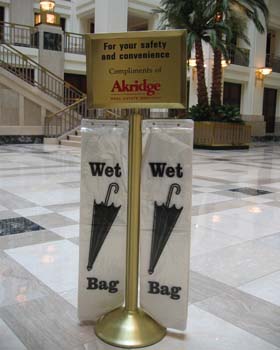
Picture the scene… it’s miserable and grey outside and raining heavily. You’re running late for a meeting, your umbrella has just managed to hold up in the gale force winds and you share an uncanny resemblance with a drowned rat. You walk into a plush hotel entrance, umbrella leaving a trail of glistening rain drops. You’re struggling! You glance anxiously about and your heart skips a beat…a stand holding bags for your wet umbrella is there, brilliant! Not so fast. Sure your problem is primarily solved and you do not soak the whole place with the rainwater but what happens when you want to dispose of the bag…there is no bin on the stand. A prime example where designers have failed to solve the whole problem. The had covered safety, ergonomics and function but had forgotten all about disposal. In a world that is constantly changing it is important for designers to adapt to the new problems facing our society and try to solve these as best as they can, without creating unnecessary issues!

I really enjoyed this lecture and felt it was useful in getting us to think broadly as a designer and understanding fully the people that we are designing for. A point that David raised and I thought was relevant was do we as students get advice in career prospects from tutors. The whole lecture theatre echoed 'no' and it was quite nice for an outsider to tell us that even if we ourselves are a little unsure of where we want to end up, it pays to be open to every possibility including service design...possibly just trying for a sale...?

With thanks:
http://www.lobbysolutions.com/images/umbrella/IMG_3163.jpg
http://www.independent.co.uk/life-style/house-and-home/interiors/annie-deakin/too-many-design-students-not-enough-jobs-1547416.html

Wednesday, 2 December 2009

Assignment 4: Reading and Reviewing


Taylor purposely sets out to highlight the differences between neighbourhoods and investigates the level of responses to disorder. He clearly delivers his ideas, educating us with the key facts needed to understand his arguments. Very quickly Taylor begins to talk about the sources he used to gather his information to write the journal. This evidence-based report relies strongly on the data gathered in research such as resident surveys, census information, on - site assessments and crime rates from 66 randomly selected neighbourhoods. From this research he is able to use the facts gathered to conduct other tests but also to make conclusions about the information gathered – context does affect how responsive we are.

Expansive research provides us with a great understanding of the underlying theme of the journal; context affects response. Taylor talks about how neighbourhoods help shape a community and also an individual. Although this point is discussed, further reading that helps reinforce this idea by looking into specific areas is “Stencil Graffiti”. Different neighbourhoods have different types of graffiti – each provoking a different level of response depending on the context in which they are placed. The environment in which individuals are placed serve as a backdrop where changes in it act as stimuli to individuals. (Manco 2002:5)

So why does context affect our responses to certain things? Taylor answers this successfully by highlighting a large amount of sources and manages to keep his personal opinions out of his writing, creating an unbiased report. Making a neutral point and then backing it up with a source meant that on reading, his report appeared creditable. Talking about local communities, Taylor presents ideas about the sense of community and value of community and refers to some local communities as “a complex system of friendship and kinship networks and formal and informal associational ties” (Kasarda and Janowitz, 1974:329; see also Hunter, 1974). Sometimes results from Taylor’s experiments placed a negative spin, for example on African – American neighbourhoods. He appeals directly to the reader that although there is significant evidence that renders this true, he also asks us to take into consideration that not every neighbourhood has been studied and so results are entirely random. By presenting us with this additional information, we are aware that he is sensitive to the fact that not every neighbourhood was part of the study.

Another method used to present sources was including test results in which Taylor asks people a number of questions about their neighbourhood (how attached they are to their neighbourhood? would a neighbour stop graffiti?, are there dangerous places to avoid?, etc), providing an honest response from local people. The results of this test reinforced the idea that different neighbourhoods work differently and that people in different neighbourhoods have different response levels to those in other neighbourhoods. Different neighbourhoods pose different threats so by creating interviews with a large variation in questions a deeper understanding can be gained when researching different opinions on a context.

One factor of a neighbourhood that acts as a threat is graffiti. Graffiti is associated with crime; place this in a neighbourhood context and the mood changes almost immediately for people. Graffiti is not the only catalyst of the change of behaviour from an individual but placed with the right conditions people become nervous and feel vulnerable – maybe because they are not exposed to graffiti on a regular basis. Taylor explains that in ‘high class’ neighbourhoods there is an uproar about graffiti because residents are not subjected to this everyday. Some residents view their neighbourhood simply as a place to live, nothing more. In contrast, other residents in neighbourhoods feel a strong sense of social attachment and are familiar with everyone in their street (Taylor 1996:42). Associations that aim to maintain high standards are now introducing schemes to help promote a better standard of living. (http://www.guardian.co.uk/politics/2009/sep/21/kent-police-crime-neighbourhood-teams (21 November 2009))


With the aim to educate people in ‘Environmental Psychology’, Tony Cassidy expresses his idea that personality doesn’t control behaviour but that setting is the reason behind our reactions. With so many questions surrounding the area of context and behaviour, the author tries to answer as many of these questions as he can using a number of sources and experiments.

One of these includes an experiment conducted by Roger Barker and Herbert Wright in 1947. Although this source is slightly dated, the information gathered is still relevant in portraying the idea that environmental factors are more important than personality. This meticulous 25 year long study by Barker monitored the effect of context on behaviour of 100 children, studying them until adulthood. At a time when video equipment was not available, the results were extremely detailed allowing reliable conclusions to be drawn from these.
“…the behaviour setting provided information in which allowed explanations for the behaviour observed. Individuals move through a wide range of behaviour settings each day, and it is not personality traits which control behaviour.” (Cassidy 2003:47)
The conclusions drawn from Barker’s experiment are very accurate due to the fact that there was so much information gathered. Comparisons could be made due to the vast amount of research collated and the number of participants that took part in the experiment and it could be concluded that there cannot be a separation of behaviour from its setting. Context can influence our experience so by watching lots of different individuals, results could be compared on their placement. By repeating similar aspects of this experiment making use of video equipment, recordings could be watched repeatedly to gain a greater understanding.

Another source, Bronfenbrenner, argues that behaviour settings offer inadequate reasons as an individual’s experience of context is not included. He argues that “behaviour settings provide incomplete explanations because they do not include the person’s experience and appraisals of the context” (Cassidy 2003:51). Bronfenbrenner disputes that response to a place is specific to an individual and personality does in fact come into it. Individuals are all brought up differently and are taught to behave differently so by placing a number of people in certain contexts they are likely to behave slightly differently - this is not due to the context but to their own individual personalities. Memories also play an important part in explaining Bronfenbrenner’s theory because an individual will remember how they behaved in an environment previously or how someone else behaved, thus influencing how they respond.

From presenting these conflicting sources, Cassidy feels strongly enough to present his own ideas about how small changes in context can have a massive impact on behaviour. These might take the form of either physical or social aspects provoking a positive or negative response from an individual. When people are presented with things that they are unfamiliar with, their behaviour changes. For example, if a person from a high class neighbourhood was presented with graffiti they may feel uneasy and threatened whereas a person from a rough neighbourhood may not respond in a negative way. Something that we are subjected to often will in time have little effect on us - presented with something new and we are more likely to respond.


Although both sources have similar underlying themes, there is a slightly different content in each source. Taylor specifically talks about behaviour in neighbourhoods and how individuals within a community can have a positive or negative response to their surroundings. Raising the issue that these small changes within context can have a massive impact, designers are now trying to accommodate these problems and are trying to come up with solutions. Designing Safer Environments echoes what is said by Taylor but shows specific examples of how each context has different problems that have been understood to enable better design solutions. For example by changing the orientation of buildings so that they overlook public spaces, we are more conscious as individuals of what is going on around us (Stephen 2006:7). By studying contrasting neighbourhoods using crime rates and photographs, one could conduct a mini experiment in which observations could be made about the design of a neighbourhood.

Instead of highlighting the small changes in contexts that can affect our behaviour, Cassidy presents us with different environments that are the most influential in imposing change to our normal behaviour, e.g. school, home, neighbourhoods. Experiments in each of these areas are presented in extensive detail creating a greater understanding of the objective, the advantage of this being that a large number of experiments have been conducted so that stronger conclusions can be made. The sources offered to us from Cassidy are all very reliable but compared to Taylor’s they are a little outdated, with one of experiments commencing in 1947. Lasting 25 years there is no denying that this experiment is extensive but conditions in these times were very different to what they are like now so it is hard to compare the results with the current circumstances. Problems faced in that period would have been different to the problems faced nowadays and a more up to date experiment could be conducted so that results could be compared from two different eras. Newspapers such as The Guardian are up to date sources about the latest attempts to try and tackle crime within a community but also they document designer’s attempts to try and solve these problems. (http://www.guardian.co.uk/society/2008/nov/19/public-services-policy-michael-bichard-design-council (2 December 2009))

Each day in different contexts, small changes can alter behaviour. An artist who uses this as a platform in which to present his work on is Banksy. It is clear that most of his designs are created to draw a response, sometimes positive but mainly negative. As Taylor and Cassidy both stress, these small changes can affect people differently and Banksy manipulates this to gain attention. By placing his stencils in the places he does he is rewarded with the maximum response and can communicate his opinions. As a designer it is important to understand certain things such as where a product is best suited and who it is best suited for. Although Banksy ‘writes on walls’, a lot of thought from his behalf goes into researching the area that will receive the most response. With different attitudes to this work it is clear that the upbringing of an individual plays an important role in interpretation, something that Taylor and Cassidy both convey - but what if they are wrong? A report by Nuffield council on Bioethics asks the questions if our genes have more to do with our behaviour than context and if anti – social behaviour has got anything to do with our upbringing? A little more research into this topic would provide a better understanding to the relationships between genetics and upbringing and the response to context. We cannot choose to ignore this source, as it may be vital in explaining other issues that context cannot.

Context and behaviour is such an interesting topic and as an Interior and Environmental Designer it is important to consider every aspect of our design and be sensitive to an environment's needs. Extensive research is required when trying to understand a context and the people that inhabit it - get this wrong and you risk upsetting whole communities!

Bibliography

Banksy, 2006, Wall and piece, Arrow Books Ltd, United Kingdom.

Barker, R.G. & Wright, H. 1955, Midwest and its children, Row and Petersen, New York.

Bronfenbrenner, U 1979, The ecology of human development, MA: Harvard University Press, Cambridge.

Cassidy, T 2003, Environmental psychology, Psychology Press, East Sussex.

Dudman, J 2008, The wow factor, The Guardian, viewed 2 December 2009, <http://www.guardian.co.uk/society/2008/nov/19/public-services-policy-michael-bichard-design-council>.

Hunter, A 1974, Symbolic communities, University of Chicago Press, Chicago.

Kasarda, J.D. & Janowitz, M 1974, ‘Community attachment in mass society’, American Socialogical Review, vol 39, 328-339.

Kennedy, I 2002, Genetics and human behaviour, Nuffield Council on Bioethics, London.

Manco, T 2002, Stencil Graffiti, Thames & Hudson, London.

Muir, H 2009, Kent police attribute massive reduction in crime to neighbourhood teams, The Guardian, viewed 21 November 2009, <http://www.guardian.co.uk/politics/2009/sep/21/kent-police-crime-neighbourhood-teams>.

Stephen, S 2006, Designing safer places, The Scottish Executive, Edinburgh.

Taylor, R. B. 1996, ‘Neighbourhood responses to disorder and local attachments: the systemic model of attachment, social disorganization, and neighbourhood use value’, Sociological Forum, vol. 11, no.1, pp. 41-74.