Friday, 19 August 2011
Riot aftermath: Community clean - up
With thanks:
BBC news - In pictures: Aftermath of the latest violence
Thursday, 18 August 2011
define: temporary.
lasting, existing, serving, or effective for a time only; not permanent: a temporary need; a temporary job.
Music festivals are temporary, so why don't we use materials to create these areas without being wasteful.
BDP architects worked with festival organisers to create the Music Box installation in Manchester, locally sourcing the shipping containers from the city's port creating a fun and creative way for people to get involved in the festival.
Other works of BDP architects include: Liverpool ONE, Glasgow Science Centre and Aintree racecourse.
lasting, existing, serving, or effective for a time only; not permanent: a temporary need; a temporary job.
Music festivals are temporary, so why don't we use materials to create these areas without being wasteful.
BDP architects worked with festival organisers to create the Music Box installation in Manchester, locally sourcing the shipping containers from the city's port creating a fun and creative way for people to get involved in the festival.
Other works of BDP architects include: Liverpool ONE, Glasgow Science Centre and Aintree racecourse.
Thursday, 21 April 2011
A new dining experience
.1
.3
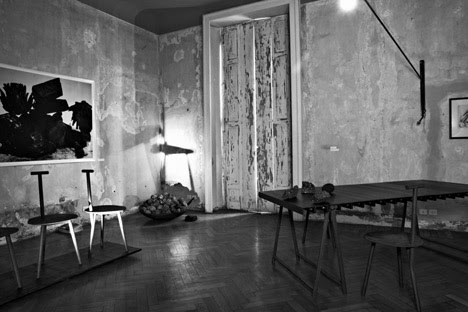
Imagine enjoying a meal in the dark though? That's exactly what diners did in Milan recently thanks to food and design collective Arabeschi de Latte. Invited by London interior designers and stylists Studio Toogood invited guests to enjoy a very different dining experience. With the underlying theme of black midnight dinners were served to a number of guests, in which all the food was black (hopefully it was not burnt!)
Some of the delicious foods on offer were cheese served on coal, burned artichokes, bread dyed with squid ink and eggs cooked in black tea. Yum! Not really for me, but I like the fact that everything within this experience all related to the 'black' theme.
As an interior designer it is an important task for us to create a whole dining experience for the guest. Considering trivial things which others may overlook are crucial in creating a space suited to the context that is being designed for. This setting totally plays on the whole idea of the overall dining experience with the only experience really being taken away is taste.
.4
Labels:
Arabeschi de Latte,
Dining,
Midnight dinner,
Studio Toogood
New website
After a lot of hard work, my first ever website has been completed. Take a look and let me know what you think.
http://rachellaing.weebly.com/
Thursday, 17 March 2011
Assignment 2b: developing the business proposal
Developing our business proposal, we all talked about the sort of thing we would like to venture into. Listening to what each of us thought and what we would like to do, we created a large mind map which allowed us to feed off of each others ideas and assist with the thought process of each other.
Once an ideas was decided, we then assigned different roles within the group according to their strengths and preferences, etc. We talked about many issues that I had not even thought to consider before and it was interesting to see how the group member's opinions differed on some of these factors. Discussing some things more than others we tried to cover as many different topics as we could.
Assignment 2a: Profiling the post consumer
Post consumer. To understand fully what this term meant, we all looked at different aspects associated with the post consumer and researched the idea into more detail to create a mood boards portraying our ideas.
Wednesday, 9 February 2011
Assignment 1: Learning styles
Working in a team this semester to develop a business proposal it is important to understand how every member of the team works and realise what people's strength are to develop the best possible concepts.
Missing the beginning of our group meetings due to my Erasmus exchange in Belgium, I had to come in a little later and understand myself what category each person within my group fell into. Straight away it was easy to see who felt confident about sharing their ideas and those who preferred to listen to others. All of these different qualities that these members possessed were important for the skill set required to complete our objective. Working off one another, the whole mixture of personalities really work well together within the group environment.
With thanks:
http://images.google.co.uk/imgres?imgurl=http://www.b-sidenation.com/images/bsidepics1/angela%2520davis1.jpg&imgrefurl=http://colorsinfluence.blogspot.com/2009/01/writer-activist-angela-davis-comes-to.html&usg=__7pjJnH1rpnnprftKPL94eQ6588c=&h=366&w=443&sz=49&hl=en&start=0&sig2=6XXXcmK0DXIz1d5vToOx0g&zoom=1&tbnid=GZkWUJlV_r1pIM:&tbnh=130&tbnw=162&ei=d_yBTbOnIoeVOryDjdYI&prev=/images%3Fq%3Dactivist%26hl%3Den%26sa%3DX%26gbv%3D2%26biw%3D1264%26bih%3D569%26tbs%3Disch:1&itbs=1&iact=rc&dur=370&oei=ZPyBTfGpOJDXsgbtl7mIAw&page=1&ndsp=21&ved=1t:429,r:11,s:0&tx=90&ty=75
Taking the learning styles survey allowed me to understand how I operate and how best I work within a team. I am an Activist.
Angela Davis. Actively involved in the economic, racial and gender equality in U.S.A.
Acting on a gut instinct and are enthusiastic about new ideas. Getting stuck in, they are not likely to prepare for learning experiences or review afterwards what they learnt. Working better with others, activists enjoy being thrown in the deep end into solving problems.
Activists are also described as people who do not enjoy listening to lectures or following rules. They do not understand things easily on their own, such as reading, writing and thinking...These were the results given by the survey and although I agree with a few of the points made, most of them I disagree with.Missing the beginning of our group meetings due to my Erasmus exchange in Belgium, I had to come in a little later and understand myself what category each person within my group fell into. Straight away it was easy to see who felt confident about sharing their ideas and those who preferred to listen to others. All of these different qualities that these members possessed were important for the skill set required to complete our objective. Working off one another, the whole mixture of personalities really work well together within the group environment.
With thanks:
http://images.google.co.uk/imgres?imgurl=http://www.b-sidenation.com/images/bsidepics1/angela%2520davis1.jpg&imgrefurl=http://colorsinfluence.blogspot.com/2009/01/writer-activist-angela-davis-comes-to.html&usg=__7pjJnH1rpnnprftKPL94eQ6588c=&h=366&w=443&sz=49&hl=en&start=0&sig2=6XXXcmK0DXIz1d5vToOx0g&zoom=1&tbnid=GZkWUJlV_r1pIM:&tbnh=130&tbnw=162&ei=d_yBTbOnIoeVOryDjdYI&prev=/images%3Fq%3Dactivist%26hl%3Den%26sa%3DX%26gbv%3D2%26biw%3D1264%26bih%3D569%26tbs%3Disch:1&itbs=1&iact=rc&dur=370&oei=ZPyBTfGpOJDXsgbtl7mIAw&page=1&ndsp=21&ved=1t:429,r:11,s:0&tx=90&ty=75
Wednesday, 19 January 2011
1 - 1 = 0?

With his unusual design concept, Alexander Hulme challenges the very basic mathematic law that 1 - 1 = 0. Normally knocking your plate off the table would result in a very messy floor and a mass of shattered pieces but this clever plate shatters in a way that you are left with two new plates. This is really quirky design idea but the only thing that gets me thinking now is what happens if you drop these two 'new' plates...?
With thanks: http://internetsiao.com/page/67/
Tuesday, 7 December 2010
Wednesday, 1 December 2010
Gevangenis bibliotheek, Antwerpen.
Prison library, Antwerp.
Yesterday we received our new interior brief...design a library within a prison for the inmates. For me I think that this is going to be a challenging project as I have strong views about the prison service. In my opinion, prisons are a place to be disciplined and for offenders to feel some remorse for the crime that has been committed so why should they be given luxuries as some are receiving such as televisions, Playstations, music, etc? Why are some people deliberately committing a crime just so that they can actually be in prison? Why should they still be allowed to enjoy hobbies such as reading and listening and watching to music and films from a variety of sources from the large collection that the prison has, surely this just defeats the whole purpose of punishment? As a designer though it is important for me to put my personal opinions aside and design neutrally, listening to what the client and users require from the space.
With a little more research into the whole topic, I understand a little more of the ideas and specifications surrounding the prison system (even if I still disagree with quite a large amount of things).
For one, the library may not have been as much as a privilege as I had first imagined for prisoners but instead acting as an aid in a bid to provide structuring for prisoners and a way to assist learning and skill development. It also encourages the inmates to make use of the libraries when they are released so as to help them reintegrate themselves into society.
As a designer it is important to understand the needs for each individual prison and the inmates that will be using the library. With a diversity of languages (sometimes 25 different nationalities), cultures, ethic origin and religion it is crucial that all of this is taken into consideration when deciding how the library will be laid out and the number of books that will be required. As this is in a closed environment it is important to consider again a number of things, are the resources suitable for prisoners? Are the materials within the library going to engage offenders into using the service? Can the space encourage inmates to use a similar service on the 'outside'?
The space in which we are to design within already houses a library but it is our job as designers to create a new innovative design that will encourage more prisoners to use the facility...considering aspects such as the opening hours, capacity, safety and size of the space will all have an influence on our final concept. How will a prisoner interact with the space? How will the way in which a guard and librarian interact differ?
Organisation of documents such as tracking stock levels and the books or other resources that each prisoner has must be designed within the space. These should only be accessible to the appropriate personnel so security issues should be considered. Also within the should there be helpful pointers to aid inmates in finding books, Dewey Decimal System...?
Safety probably is one of the main issues that I need to tackle within the space as some people who are coming to visit the library may not primarily be there to just pick a book... According to prison library specifications it is important to incorporate a number of elements such as formal and informal areas, general display areas, a separate staff area, etc.
The whole project ties in nicely with a topic I want to explore as a possible dissertation subject and as our tutors here in Mechelen keep reinforcing the point that space does influence the way in which we behave, it is important for me to use the data I have already gathered for my dissertation to aid me with this but also be prepared to discover new points that I can add to it too. In the case of this project the design we create should be aimed at trying to ease the stay of convicts and help them try and channel energies towards a positive outcome.
Basically what I am trying to say is that lots and lots need to be considered and after doing some research into the subject I now have a greater understanding. Although most of my original views remain the same, I have changed my feelings towards the library space within the prison. What I originally thought was just a place for the inmates to escape the area in which they are being disciplined in, now I understand to be so much more...a place to try and encourage learning and those who wish, an opportunity to prepare themselves for a new life outside the 4 walls of their cells.
With thanks:
Author unknown 2010, Prison libraries specification, Waterside Press, London.
Yesterday we received our new interior brief...design a library within a prison for the inmates. For me I think that this is going to be a challenging project as I have strong views about the prison service. In my opinion, prisons are a place to be disciplined and for offenders to feel some remorse for the crime that has been committed so why should they be given luxuries as some are receiving such as televisions, Playstations, music, etc? Why are some people deliberately committing a crime just so that they can actually be in prison? Why should they still be allowed to enjoy hobbies such as reading and listening and watching to music and films from a variety of sources from the large collection that the prison has, surely this just defeats the whole purpose of punishment? As a designer though it is important for me to put my personal opinions aside and design neutrally, listening to what the client and users require from the space.
With a little more research into the whole topic, I understand a little more of the ideas and specifications surrounding the prison system (even if I still disagree with quite a large amount of things).
For one, the library may not have been as much as a privilege as I had first imagined for prisoners but instead acting as an aid in a bid to provide structuring for prisoners and a way to assist learning and skill development. It also encourages the inmates to make use of the libraries when they are released so as to help them reintegrate themselves into society.
As a designer it is important to understand the needs for each individual prison and the inmates that will be using the library. With a diversity of languages (sometimes 25 different nationalities), cultures, ethic origin and religion it is crucial that all of this is taken into consideration when deciding how the library will be laid out and the number of books that will be required. As this is in a closed environment it is important to consider again a number of things, are the resources suitable for prisoners? Are the materials within the library going to engage offenders into using the service? Can the space encourage inmates to use a similar service on the 'outside'?
The space in which we are to design within already houses a library but it is our job as designers to create a new innovative design that will encourage more prisoners to use the facility...considering aspects such as the opening hours, capacity, safety and size of the space will all have an influence on our final concept. How will a prisoner interact with the space? How will the way in which a guard and librarian interact differ?
Organisation of documents such as tracking stock levels and the books or other resources that each prisoner has must be designed within the space. These should only be accessible to the appropriate personnel so security issues should be considered. Also within the should there be helpful pointers to aid inmates in finding books, Dewey Decimal System...?
Safety probably is one of the main issues that I need to tackle within the space as some people who are coming to visit the library may not primarily be there to just pick a book... According to prison library specifications it is important to incorporate a number of elements such as formal and informal areas, general display areas, a separate staff area, etc.
The whole project ties in nicely with a topic I want to explore as a possible dissertation subject and as our tutors here in Mechelen keep reinforcing the point that space does influence the way in which we behave, it is important for me to use the data I have already gathered for my dissertation to aid me with this but also be prepared to discover new points that I can add to it too. In the case of this project the design we create should be aimed at trying to ease the stay of convicts and help them try and channel energies towards a positive outcome.
Basically what I am trying to say is that lots and lots need to be considered and after doing some research into the subject I now have a greater understanding. Although most of my original views remain the same, I have changed my feelings towards the library space within the prison. What I originally thought was just a place for the inmates to escape the area in which they are being disciplined in, now I understand to be so much more...a place to try and encourage learning and those who wish, an opportunity to prepare themselves for a new life outside the 4 walls of their cells.
With thanks:
Author unknown 2010, Prison libraries specification, Waterside Press, London.
Labels:
Antwerp,
Gevangenis bibliotheek,
Library,
Prison
Wednesday, 24 November 2010
Exhibit: Lil' & LARGE
Our hard work for the past 8 weeks has finally paid off and we have now finished our GIDE project.
Lil' & Large.
7 European Design Schools. 1 competition. 1 common theme: Exhibit.Creating a group of students - 2 Belgian and 2 Scottish - the answer to this question was very varied! Talking extensively about different elements of exhibition design such as interaction and location, we wanted to make sure that we discussed as much as we could at this stage to feel more confident about tackling the brief.
After our group brainstorming session we all decided we liked the idea of a Pop up exhibition, allowing as many people the chance to see it as possible. Most people when they hear pop up would typically think of a book from childhood where the story came alive when the scene spread across their lap...a similar experience we wanted to create with our exhibition.
Playing on the word 'POP UP' we began sketching ideas with this as the underlying concept and from the obvious to abstract. With a very 'childlike' reference to pop up we thought it appropriate to 'exhibit' a child's clothing range called Oilily, as we felt the brand fitted well with our pop up concept. The brand boasts an impressive range from dresses to handbags decorated with bold patterns that are instantly recognisable.
Presenting a mood board a few weeks into the project we were able to highlight our inspiration for our design. Creating an unconventional mood board, we talked about our ideas using the elements of a pop up book. Created with interaction in mind we wanted to heighten the understanding of our theme through interaction. Research images were on a pull out slide and to see all of these you had to slide and also flip the card over. Within our group we created large 'sketch book pages' and scribbled all our ideas relating to our topic trying to create visually what we interpreted the term pop up to be. Naturally everybody had different ideas surrounding pop up so we tried to incorporate these elements to create the strongest concept. Looking at the way in which a Russian Doll is able to transform itself from being one object into many without a drastic change in form was something that we used as inspiration for creating the form of our pop up exhibition.
Obviously with our pop up requiring to be moved to different locations we had to consider issues such as weight, stability, materials, portability and size. Attending a recent furniture exhibition in Kortrijk, Belgium we were able to gather information about the different types of materials that were available to us and what sort of attributes they possess but also discuss the problems we were facing with these issues and the problems that these designers had overcome. The material that we have decided to use is CARDBOARD. BEE®lite manufacture high quality honeycomb panels that can be used for both temporary and permanent purposes. These panels are lightweight which are vital for an exhibition that will constantly be on the move and can be erected quickly as there are no tools required. The Oilily pattern will be printed on the outside of these with each building being a different colour and the interior space will be colourless to allow the clothes to ‘pop’ from the backdrop.
All the ‘houses’ are separate so as the exhibition can be altered to suit the location it will be situated in. From old buildings to shopping centres to art galleries, small or large the design allows the exhibition to accommodate for all the different locations that we intend to visit and give people the chance to experience the exciting brand that is Oilily.
Final board...coming soon.
Tuesday, 23 November 2010
Furniture made to measure
New project. New brief.
Another group project at Lessius in which we have to design the new STIPhuis. The STIPhuis is a place for students to go if they have any problems but is mainly used by international students who wish to voice any concerns and also do laundry. The current STIPhuis is too small for the functions it is required to perform and is to be located to a new, larger building 3 doors down the street. It's our job as designers to communicate and work with both the clients and users to best utilise the new space.
Using some of the techniques I learned last year as research methods we were able to gain an insight into the users of the space. Asking the STIP staff members about the STIPhuis they currently worked in, we asked questions such as what do you require from the space? What works within this current space? What would you like to see within the new space? Taking these results into consideration we took this forward when creating our space.
Friday, 12 November 2010
Delving into my world of thoughts...
Dissertation.
Part 1.
Part 2.
Part 3.
Part 4.
Identifying 8 key words from the core theme of 'crime and design' I was able to think about my topic in more detail and highlight areas in which I might look into further. After meeting up with other classmates, the ideas I jotted down were discussed further and I was able to reinforce points to them that I felt were important to the whole core theme.
Selecting criteria in which I wanted to take forward and possibly explore allowed me to create a list in which I thought points on it would prove useful for further research. Looking more closely at methods which have been successful/unsuccessful into crime prevention, aspects which cause an individual to act in a certain manner within an environment...
Questioning what I had already explored allowed me to look into more detail parts I thought were most relevant to the points that I wanted to continue look at. Asking myself questions I could begin to answer these using parts of the research I had already gathered looking into the theme of crime and design.
Looking at things in a more refined view and breaking down the topic into smaller chunks I could begin to select parts which were most relevant to me. Detailing parts such as further research I could do and people I would need to speak to got me realistically thinking about the whole dissertation process.
Labels:
Crime and Design,
Discussing,
Dissertation,
Thinking,
Worksheets
Subscribe to:
Comments (Atom)